


When to Buy a Business vs an Apartment Building
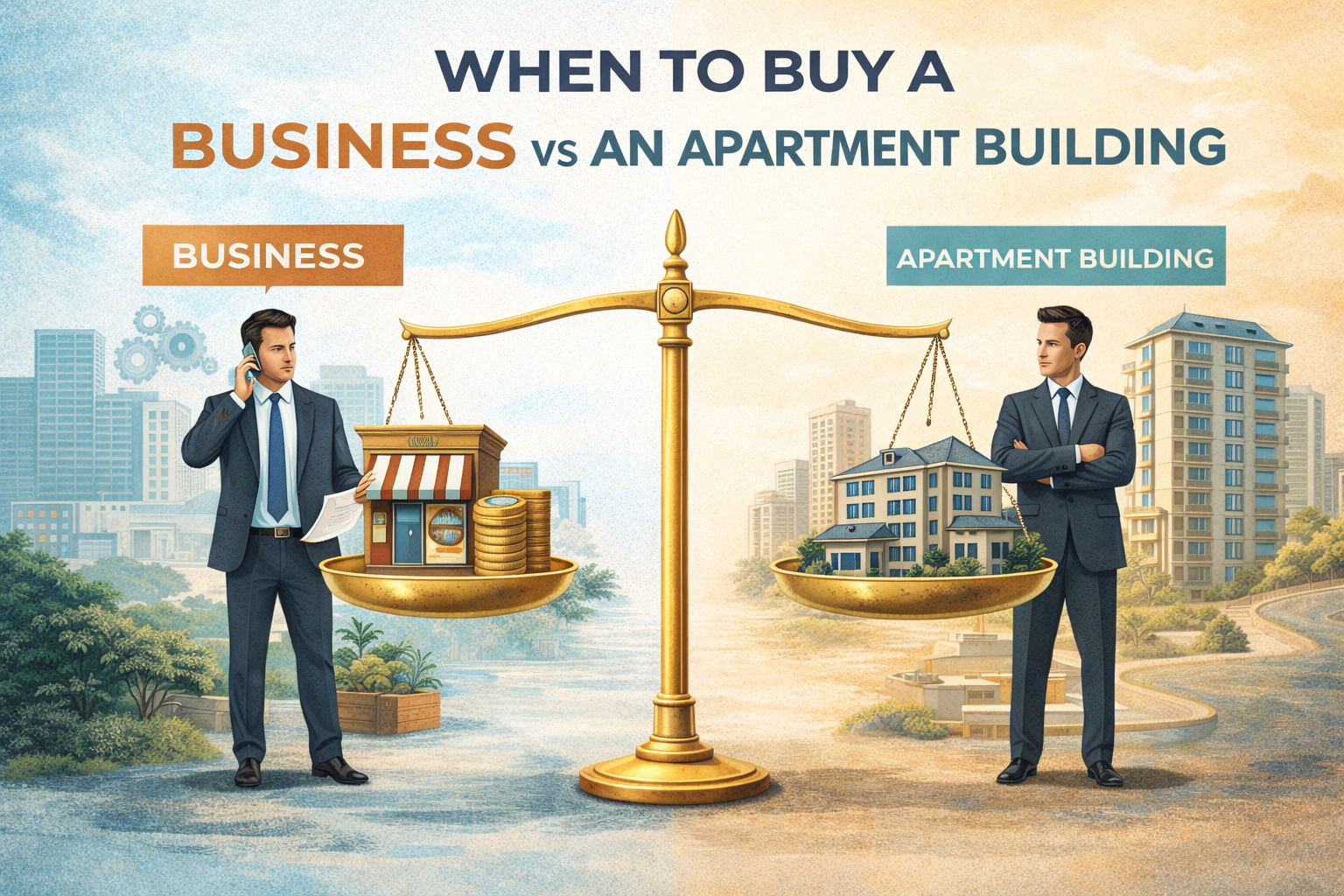
Investors often compare buying a business with buying an apartment building as if the two opportunities sit on the same decision plane. In reality, they represent fundamentally different capital roles, risk profiles, and management obligations.
Rather than asking which option offers higher returns, experienced investors ask when each makes sense. As a result, the decision becomes contextual, shaped by timing, experience, and portfolio structure rather than preference.
This article explains how investors think about the choice between buying a business and acquiring an apartment building, with a focus on opportunity cost, risk containment, and long-term capital resilience.
Why This Comparison Is Often Framed Incorrectly
At a surface level, both businesses and apartment buildings produce cash flow. However, that similarity hides important structural differences.
Cash Flow Is Not the Same as Control
While both assets generate income, they do so through different mechanisms. In an apartment building, cash flow is distributed across multiple tenants and governed by leases. In a business, cash flow is often concentrated in operations, customers, or contracts.
Therefore, the stability of income depends not just on revenue, but on how that revenue is produced and defended.
How Apartment Buildings Function as an Investment
Apartment buildings are asset-backed investments with predictable demand drivers.
In most cases, revenue is diversified across many tenants, while expenses and debt structures are known in advance. As a result, downside risk is often more visible and easier to model.
Strengths of Apartment Building Investments
Apartment buildings typically offer:
- Tangible asset backing
- Fragmented income sources
- Easier financing and refinancing options
- Greater transparency in valuation
Consequently, apartment investments often perform well as capital-preservation vehicles across market cycles.
Limitations of Apartment Building Investments
However, apartment buildings are not risk-free.
For example, they remain sensitive to interest rates, operating costs, and regulatory changes. Additionally, returns may be capped without operational improvements or favorable market conditions.
How Businesses Function as an Investment
Buying a business means acquiring an operating system, not just an asset.
In contrast to real estate, business value is often tied to people, processes, and competitive positioning. Therefore, performance depends heavily on execution quality.
Strengths of Business Acquisitions
Businesses can offer:
- Higher cash-on-cash yields
- Greater operational leverage
- Faster value creation through execution
When managed well, businesses can accelerate capital growth more quickly than stabilized real estate.
Limitations of Business Acquisitions
At the same time, business acquisitions introduce concentrated risks.
For instance, customer churn, key-person dependency, or operational failures can rapidly impair value. As a result, downside scenarios may unfold faster and with less warning.
Risk Profile Differences That Matter Most
Experienced investors focus less on headline returns and more on how risk behaves under stress.
In downturns, apartment buildings often experience slower degradation due to diversified tenancy. By contrast, businesses may experience abrupt revenue declines if demand contracts or costs spike.
Therefore, risk asymmetry plays a central role in deciding which asset fits a given stage of an investor’s journey.
Liquidity and Exit Considerations
Liquidity differs meaningfully between these two investment types.
Generally, apartment buildings benefit from deeper buyer pools and standardized valuation frameworks. Meanwhile, businesses often require bespoke buyers, extended due diligence, and seller financing structures.
Consequently, exit flexibility becomes a critical component of opportunity cost.
Management Intensity and Time Commitment
Time is a hidden but decisive factor.
While apartment buildings can be professionally managed with limited owner involvement, businesses usually demand closer oversight. Therefore, an investor’s available attention directly influences which option is appropriate.
This distinction becomes increasingly important as portfolios grow or personal priorities change.
When Buying an Apartment Building Makes More Sense
Buying an apartment building is often appropriate when:
- Capital preservation is a priority
- The investor values predictable income
- Time availability is limited
- Portfolio stability outweighs aggressive growth
In these situations, apartments serve as durable foundations rather than acceleration tools.
When Buying a Business Makes More Sense
Buying a business may be appropriate when:
- The investor has operational experience
- Systems and management frameworks are proven
- Risk can be actively monitored and mitigated
- Capital growth is prioritized over stability
Provided that execution risk is understood, businesses can play a powerful role in portfolio expansion.
How Experienced Investors Sequence These Choices
Rather than choosing one permanently, experienced investors often sequence these assets.
Early on, they may prioritize businesses to grow capital quickly. Over time, they may rotate capital into apartment buildings to stabilize income and reduce volatility.
In this way, each asset serves a distinct purpose within a broader allocation strategy.
A Final Decision Framework
The decision is not business versus apartments. Instead, it is about alignment.
Experienced investors ask:
- What role should this capital play right now?
- How does this choice affect downside risk?
- What does it limit or enable in the future?
Ultimately, the correct choice is the one that preserves optionality while advancing long-term objectives.