


Passive vs Active Investing Explained
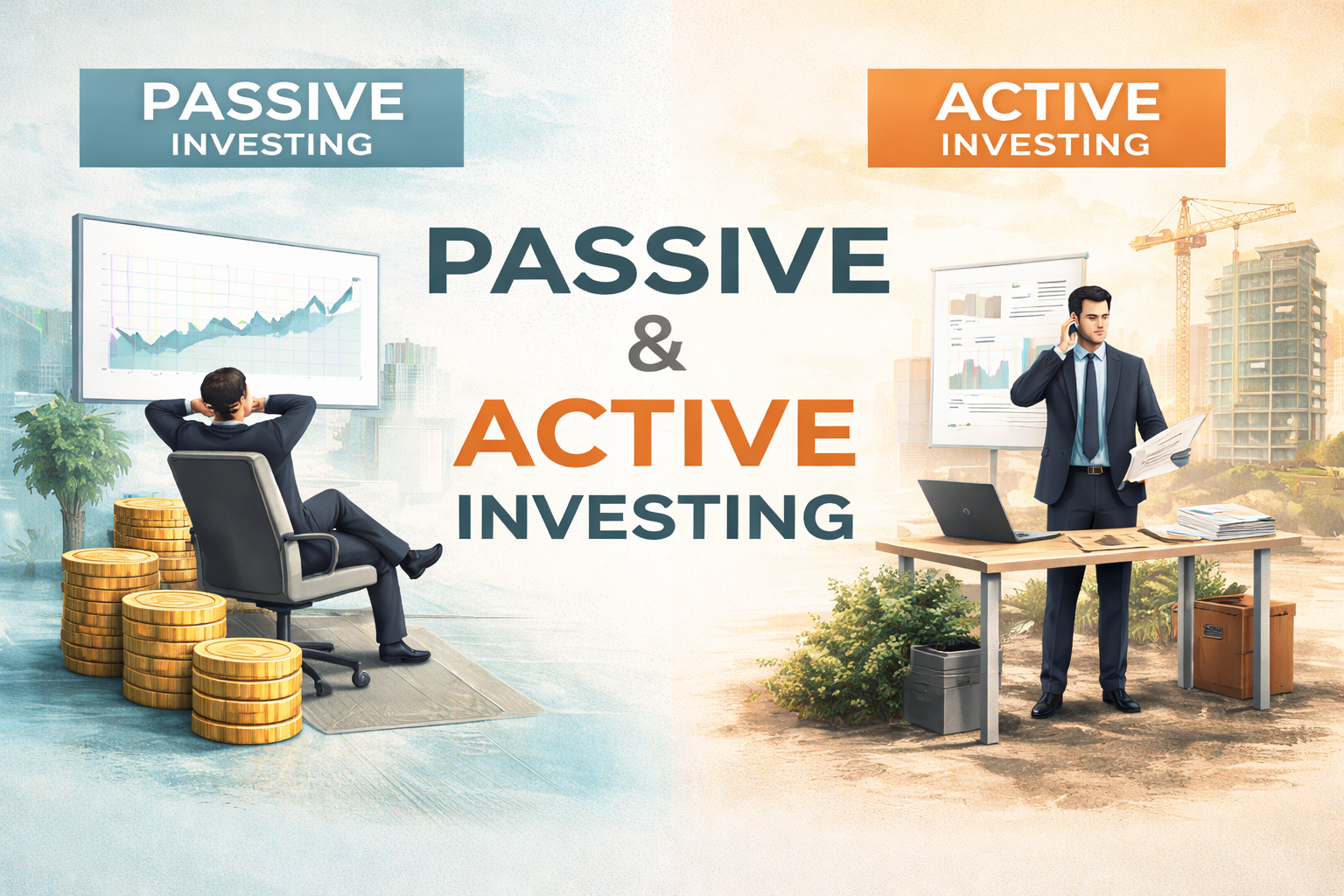
Investors often frame the choice between passive and active investing as a preference issue. In reality, it is a capital allocation decision that determines how risk, time, and responsibility are distributed over the life of an investment.
As a result, understanding this distinction early helps investors avoid mismatches between strategy, capability, and long-term goals. Moreover, it clarifies why some investors compound steadily across cycles while others stall despite favorable market conditions.
In this guide, passive and active investing are explained from a first-principles perspective, with a clear focus on decision-making, risk exposure, and capital preservation.
What Passive Investing Actually Means
Passive investing is defined by the delegation of execution, not by the absence of thought.
In practice, a passive investor allocates capital to assets or operators where:
- Day-to-day decisions are made by others
- Operational control is limited or non-existent
- Returns depend on manager performance, structure, and alignment
The investor’s role shifts upstream. The work happens before capital is deployed, not after.
Key Characteristics of Passive Investing
Passive investing typically involves:
- Limited decision rights after investment
- Reliance on reporting rather than direct control
- Exposure to structural and governance risk
Common passive structures include limited partnership interests, funds, and professionally managed real estate investments.
The Real Risk in Passive Investing
The primary risk in passive investing is misplaced trust.
Because operational control is delegated, outcomes depend on:
- Incentive alignment
- Capital structure
- Risk management discipline
- Transparency and governance
Passive does not mean low risk. It means indirect risk.
What Active Investing Actually Means
Active investing means retaining decision authority over capital deployment and operations.
An active investor:
- Influences or controls execution
- Makes real-time decisions under uncertainty
- Is directly responsible for outcomes
This includes owning and operating assets, leading acquisitions, or acting as a general partner in structured investments.
Key Characteristics of Active Investing
Active investing typically involves:
- Ongoing decision-making responsibility
- Operational and execution risk
- Greater exposure to both upside and downside variance
Returns are not only market-driven but operator-dependent.
The Real Risk in Active Investing
The primary risk in active investing is overestimating capability.
Active strategies fail when:
- Systems are weak
- Decisions are emotional rather than structured
- Scale outpaces experience
Control increases responsibility. Without discipline, control amplifies mistakes.
Passive vs Active Is Not a Binary Choice
Most experienced investors do not choose one permanently.
Instead, they sequence passive and active strategies over time.
The relevant question is not:
“Which is better?”
The correct question is:
“Which role should my capital play at this stage?”
Factors That Influence the Right Choice
The decision depends on:
- Available time and attention
- Experience with risk and execution
- Portfolio concentration
- Income stability outside the investment
What is appropriate early in an investing journey may be inefficient later, and vice versa.
Capital Preservation Comes First
Across market cycles, capital preservation is the constraint that governs both strategies.
Passive investors preserve capital by:
- Avoiding leverage mismatches
- Prioritizing structure and downside protection
- Selecting conservative operators
Active investors preserve capital by:
- Maintaining liquidity buffers
- Stress-testing assumptions
- Scaling only after systems are proven
Neither approach is inherently safer. Structure and discipline matter more than labels.
How Experienced Investors Think About the Trade-Off
Sophisticated investors view passive and active investing as roles, not identities.
They ask:
- Where does my capital earn its highest risk-adjusted return?
- Where does my involvement create the most value?
- Where am I exposed to risks I cannot control or understand?
These questions guide allocation far more reliably than market sentiment or trend cycles.
When Passive Investing Makes Sense
Passive investing is often appropriate when:
- The investor has limited time availability
- The opportunity requires specialized execution
- Capital preservation is prioritized over growth
- The structure clearly defines downside risk
Used correctly, passive investing allows capital to work without demanding continuous involvement.
When Active Investing Makes Sense
Active investing is often appropriate when:
- The investor has repeatable systems
- Execution skill is proven
- Risk can be actively managed
- The opportunity requires direct oversight
Active investing is not about effort. It is about decision quality under pressure.
A Final Framing
Passive and active investing are not competing philosophies. They are tools.
Long-term investors learn to deploy each deliberately, based on context rather than ideology. The goal is not activity. The goal is resilient capital allocation across cycles